

Introduction
In modern wireless communication, timing plays a critical role in ensuring smooth and accurate data transmission. One important concept that often confuses beginners is the timing advance processor. If you’ve ever wondered how mobile networks keep signals synchronized between your device and the base station, this is where it comes in. A timing advance processor helps adjust signal timing so that communication remains efficient, even when users are moving. In this article, we’ll break down this concept in a simple and practical way, so you can clearly understand how it works and why it matters.
What is a Timing Advance Processor?
A timing advance processor is a component or algorithm used in wireless communication systems to adjust the timing of signals sent from a mobile device to a base station. Its main purpose is to ensure that signals from different users arrive at the base station at the correct time, avoiding overlap and interference.
In cellular networks like 4G LTE and 5G, many users share the same frequency channels. Without proper timing control, signals from devices at different distances would arrive at different times, causing data errors. The timing advance processor solves this by calculating how early a device should send its signal.
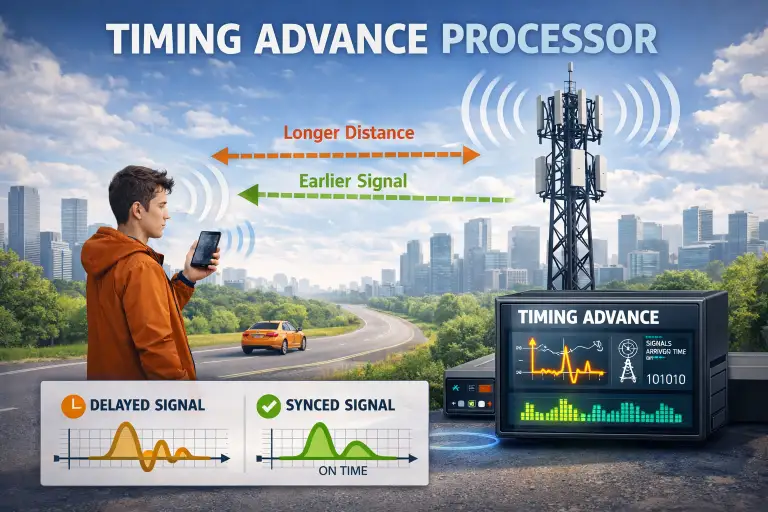
In simple terms, it tells your phone: “Send your data a little earlier so it reaches the tower exactly on time.”
Why Timing Advance is Important
Wireless communication relies heavily on synchronization. When multiple devices communicate with a base station, their signals must align perfectly in time.
Here’s why timing advance processing is essential:
- It prevents signal collision between multiple users
- It improves data accuracy and reduces errors
- It enhances overall network efficiency
- It supports seamless communication for moving users
Imagine several people trying to speak at the same time in a meeting. Without coordination, the message becomes unclear. Timing advance ensures everyone “speaks” at the right moment.
How a Timing Advance Processor Works
The working process of a timing advance processor is quite logical when broken down into steps.
Step 1: Distance Estimation
The base station measures how long it takes for a signal to travel from the device to itself. Since radio signals travel at the speed of light, this time delay indicates the distance between the user and the tower.
Step 2: Timing Calculation
Based on this delay, the system calculates how much earlier the device should transmit its signal. This value is called the timing advance value.
Step 3: Command Transmission
The base station sends this timing adjustment instruction back to the device.
Step 4: Signal Adjustment
The device adjusts its transmission timing accordingly, ensuring that its signal arrives in sync with others.
This process happens continuously, especially when the user is moving, such as during a phone call in a car.
Timing Advance in LTE and 5G Networks
Timing advance processing is widely used in modern cellular technologies.
LTE (4G)
In LTE networks, timing advance is crucial because the system uses uplink synchronization. The base station continuously monitors signal timing and updates the device with new values.
The timing advance value in LTE is typically updated every few milliseconds, ensuring accurate synchronization even in fast-moving scenarios.
5G Networks
In 5G, the concept is still relevant but more advanced. With technologies like beamforming and ultra-low latency, timing precision becomes even more critical.
The timing advance processor in 5G systems works with more complex algorithms and supports higher data rates and more connected devices.
Real-Life Example
Let’s make this easier with a real-world example.
Imagine you are standing far away from a cellular tower, while another user is very close to it.
- Your signal takes longer to reach the tower
- The nearby user’s signal arrives faster
Without timing adjustment, your signal would arrive late and cause misalignment.
The timing advance processor fixes this by instructing your device to send data slightly earlier. This ensures both signals arrive at the same time, keeping communication smooth.
Key Components Involved
A timing advance processor is not always a single physical device. It can be part of a system that includes:
- Base station (eNodeB in LTE, gNodeB in 5G)
- Mobile device (UE – User Equipment)
- Signal processing algorithms
- Network synchronization modules
These components work together to maintain accurate timing across the network.
Challenges in Timing Advance Processing
While timing advance processing is highly effective, it also comes with challenges.
Mobility Issues
When users move quickly, such as in vehicles, the distance changes rapidly. The processor must continuously update timing values in real time.
Signal Interference
Environmental factors like buildings, weather, and obstacles can affect signal propagation, making timing estimation more complex.
High Network Load
In crowded areas with many users, managing timing for multiple devices becomes more demanding.
Despite these challenges, modern networks use advanced algorithms to handle these issues efficiently.
Benefits of Timing Advance Processor
The timing advance processor offers several advantages that improve overall network performance.
- Better synchronization between devices and base stations
- Reduced signal interference and collision
- Improved call quality and data transmission
- Efficient use of network resources
- Support for high-speed mobility
These benefits make it a fundamental part of modern wireless systems.
Key Takeaways
- A timing advance processor adjusts when a device sends signals to match network timing
- It ensures signals from multiple users arrive at the base station simultaneously
- It is essential for LTE and 5G network performance
- The system continuously updates timing values based on user movement
- It helps reduce interference and improve communication quality
FAQ Section
What is timing advance in simple words?
Timing advance is a method used to make sure signals from your phone reach the network at the correct time by sending them slightly earlier.
Why is a timing advance processor needed?
It is needed to prevent signal overlap and ensure smooth communication between multiple users and the base station.
Does timing advance affect internet speed?
Indirectly, yes. Proper timing improves network efficiency, which can lead to better data performance and fewer errors.
Is timing advance used in 5G?
Yes, timing advance is still used in 5G, but with more advanced and precise processing techniques.
Can timing advance change while using a phone?
Yes, it changes continuously, especially when you are moving, to maintain accurate synchronization.
Is timing advance related to distance?
Yes, the timing advance value is directly based on the distance between your device and the base station.
Conclusion
The timing advance processor is a key part of modern wireless communication that often works behind the scenes. It ensures that signals from different users arrive at the right time, maintaining smooth and reliable communication. Whether you are making a call, browsing the internet, or streaming videos, this system plays a vital role in keeping everything synchronized. As networks continue to evolve with 5G and beyond, timing advance processing will remain essential for delivering fast, efficient, and seamless connectivity.