

Introduction
In digital electronics and computer engineering, recognizing patterns in data is a fundamental task. One important concept that makes this possible is the sequence detection system. Whether it’s identifying a specific binary pattern in a communication signal or controlling operations in embedded systems, this concept plays a key role behind the scenes.
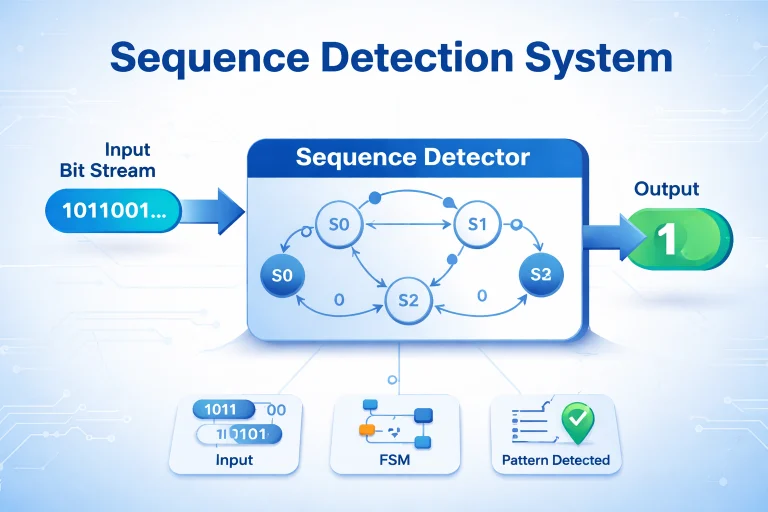
A sequence detection system is designed to monitor a stream of bits and detect a predefined pattern, such as 101 or 1001. It is widely used in hardware design, especially where real-time decision-making is required. In this guide, you’ll learn how it works, its types, and how engineers design it using finite state machines.
Understanding a Sequence Detection System
A sequence detection system is a digital circuit that scans a serial input stream and produces an output when a specific sequence of bits is detected. The system processes one bit at a time and keeps track of previously received bits to determine whether the desired pattern has occurred.
At its core, this system relies on a Finite State Machine, which allows it to move between different states based on input conditions. Each state represents how much of the desired sequence has been recognized so far.
For example, if the system is designed to detect the sequence 101, it doesn’t simply wait for three bits at once. Instead, it checks each incoming bit and updates its state accordingly until the pattern is fully matched.
How Sequence Detection Works
The working principle of a sequence detection system is based on tracking partial matches. Instead of starting over with each new bit, the system remembers what it has already seen.
Let’s take a simple example of detecting the sequence 010. The system might follow this logic:
- Initially, nothing is detected
- When it sees 0, it moves to a state indicating the first bit is matched
- When it sees 01, it moves to the next state
- When 010 is completed, the output becomes 1
This process happens continuously as new bits arrive. The system doesn’t stop after one detection—it keeps scanning for more patterns in the stream.
Types of Sequence Detection Systems
Sequence detectors are mainly classified into two types based on how they handle overlapping patterns.
Overlapping Sequence Detector
An overlapping sequence detector allows part of a detected sequence to be reused as the beginning of a new sequence. This makes it more efficient when patterns repeat closely.
For instance, consider detecting 101 in the input 10101. The system detects the first 101, and instead of resetting completely, it uses the last 1 as the start of a new sequence. As a result, it detects two occurrences.
This approach is commonly used in communication systems where continuous data streams need efficient pattern recognition.
Non-Overlapping Sequence Detector
A non-overlapping sequence detector resets completely after detecting a sequence. It does not reuse any part of the previous pattern.
Using the same example 10101, this type would detect only one occurrence of 101 because it restarts after the first detection.
This method is simpler and easier to design but may miss closely repeated patterns.
Role of Finite State Machines in Sequence Detection
Finite state machines are the backbone of every sequence detection system. They provide a structured way to design circuits that depend on both current input and previous history.
There are two main types of FSMs used in sequence detection:
Mealy Machine
In a Mealy machine, the output depends on both the current state and the input. This means the output can change immediately when the input changes.
This model is faster and often requires fewer states, making it efficient for hardware implementation.
Moore Machine
In a Moore machine, the output depends only on the current state. The output changes only when the system transitions to a new state.
Although slightly slower, this model is more stable and easier to understand, especially for beginners.
Design Components of a Sequence Detection System
To design a sequence detection system, engineers focus on several key components.
Input Bit Stream
The input is a continuous stream of binary data (0s and 1s). The system processes one bit at a time in sequence.
States
States represent the progress of matching the desired pattern. Each state corresponds to a partial match of the sequence.
Transition Logic
This defines how the system moves from one state to another based on the current input. It ensures that the system correctly tracks the sequence.
Output
The output becomes 1 when the complete sequence is detected. Otherwise, it remains 0.
Step-by-Step Example
Let’s consider designing a detector for the sequence 1001.
- Start with an initial state where no bits are matched
- Move to the next state when the first 1 is detected
- Continue tracking as 10, then 100
- When 1001 is fully matched, the output becomes 1
After detection, the system either resets (non-overlapping) or continues from a partial state (overlapping), depending on the design.
This step-by-step tracking ensures accurate detection even in long and complex input streams.
Real-World Applications
Sequence detection systems are used in many practical areas of technology. They are not just theoretical concepts but are actively implemented in modern systems.
Some common applications include:
- Digital communication systems for detecting specific bit patterns
- Error detection and correction mechanisms
- Embedded systems and microcontrollers
- Signal processing and control systems
- Pattern recognition in hardware circuits
In communication systems, for example, detecting specific sequences helps identify frames or synchronization patterns in transmitted data.
Common Challenges in Design
Designing an efficient sequence detection system is not always straightforward. Engineers must consider several challenges:
- Handling overlapping patterns correctly
- Minimizing the number of states for efficiency
- Ensuring fast and accurate detection
- Avoiding incorrect detections due to noise or unexpected input
Careful planning and testing are required to ensure the system performs reliably in real-world conditions.
Key Takeaways
- A sequence detection system identifies specific bit patterns in a serial stream
- It is implemented using finite state machines
- Two main types exist: overlapping and non-overlapping detectors
- Mealy and Moore machines are commonly used design models
- These systems are widely used in communication and embedded systems
FAQs
What is a sequence detection system used for?
It is used to identify specific patterns in binary data streams, especially in digital communication and control systems.
What is the difference between overlapping and non-overlapping detectors?
Overlapping detectors reuse part of a previous sequence, while non-overlapping detectors reset completely after detection.
Which is better: Mealy or Moore machine?
Both have advantages. Mealy machines are faster and use fewer states, while Moore machines are simpler and more stable.
Can sequence detection be implemented in software?
Yes, although it is most commonly used in hardware, similar logic can be implemented in software algorithms.
Why are finite state machines important in sequence detection?
They allow the system to track previous inputs and manage transitions effectively, making pattern detection possible.
Conclusion
A sequence detection system is a powerful concept in digital electronics that enables machines to recognize patterns in real time. By using finite state machines, these systems can track input data efficiently and respond instantly when a specific sequence is detected.
Understanding how sequence detectors work gives you a strong foundation in digital design. Whether you are a student, engineer, or enthusiast, mastering this concept opens the door to designing smarter and more efficient systems. As technology continues to evolve, sequence detection remains a critical tool in building reliable communication and control systems.