

Introduction
In modern mobile networks, the ability to instantly access subscriber information is critical for delivering fast, reliable services. One important mechanism that makes this possible is any time interrogation. If you’ve ever wondered how telecom systems can check a user’s location, status, or device details in real time, ATI is a key part of that process.
This article explains what any time interrogation is, how it works in GSM and SS7 networks, and why it matters for both telecom operators and users. Whether you’re a beginner or someone exploring telecom concepts, you’ll find a clear and practical breakdown here.
What Is Any Time Interrogation?
Any time interrogation (ATI) is a signaling procedure used in mobile networks that allows authorized systems to request subscriber information from core network databases at any moment. It is part of the GSM MAP (Mobile Application Part) protocol and operates within the SS7 signaling framework.
In simple terms, ATI lets a system ask the network:
“Give me the current status or location of this subscriber right now.”
Unlike other processes that depend on user activity, ATI works independently. It does not require the user to make a call, send a message, or trigger any event.
Why Any Time Interrogation Matters in Telecom
Telecom networks are built to handle millions of users simultaneously. To manage this efficiently, operators need quick access to real-time subscriber data.
Any time interrogation plays a crucial role because it:
- Enables real-time decision-making in network services
- Supports location-based services and applications
- Helps manage roaming and billing systems
- Improves network monitoring and troubleshooting
Without ATI, many telecom services would experience delays or rely on outdated information.
How Any Time Interrogation Works
Basic Network Components Involved
To understand ATI, it helps to know the key network elements:
- HLR (Home Location Register): Stores permanent subscriber data
- HSS (Home Subscriber Server): Advanced version of HLR in LTE/4G
- VLR (Visitor Location Register): Tracks users in a specific area (voice domain)
- SGSN (Serving GPRS Support Node): Handles data services in 2G/3G
- CAMEL Application (gsmSCF): Service logic that triggers ATI requests
Step-by-Step Process
When an ATI request is triggered, the process typically follows these steps:
- A service application (such as CAMEL) sends an ATI request
- The request is directed to the HLR or HSS
- The HLR checks with relevant nodes:
- VLR for voice-related status
- SGSN for data-related status
- The network gathers the requested information
- The response is sent back instantly to the requesting system
This entire process happens in milliseconds, allowing real-time data retrieval.
What Information Does ATI Provide?
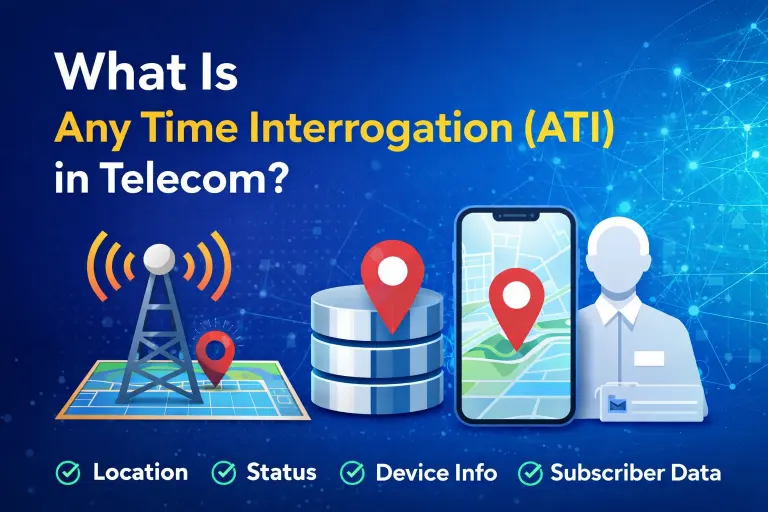
Any time interrogation can retrieve several types of subscriber data, including:
Location Information
ATI can provide the last known location of a user, typically in the form of a GSM cell ID. This indicates which cell tower the device is connected to.
Subscriber Status
It shows whether the user is:
- Attached (connected to the network)
- Detached (not connected)
- Reachable or unreachable
Device Information
ATI may return the IMEI, which identifies the user’s device.
Subscriber Identity
It can also include identifiers such as IMSI, which uniquely represents the subscriber in the network.
ATI in GSM, 3G, and LTE Networks
Any time interrogation originated in GSM networks but has evolved over time.
GSM and 2G Networks
In GSM, ATI is part of the MAP protocol within SS7 signaling. It mainly interacts with the HLR and VLR.
3G Networks
In 3G, ATI continues to function similarly but integrates with SGSN for packet-switched data.
LTE and 4G Networks
In LTE, the HLR is replaced by the HSS. While signaling methods have evolved, the concept of querying subscriber data in real time remains the same.
Real-World Use Cases of Any Time Interrogation
ATI is not just a technical concept—it is actively used in many telecom operations.
Location-Based Services
Services like emergency response systems or location tracking rely on ATI to determine a user’s position.
Roaming Management
When users travel across networks, ATI helps operators track their status and ensure seamless connectivity.
Billing and Charging
Telecom operators use ATI to verify subscriber status before applying charges or services.
Network Monitoring
Engineers use ATI to troubleshoot issues and monitor subscriber activity in real time.
Security and Privacy Concerns
While any time interrogation is useful, it also raises important security concerns.
In older SS7-based networks, vulnerabilities allowed unauthorized entities to send ATI requests. This could potentially expose sensitive information like a user’s location.
Risks Associated with ATI
- Unauthorized tracking of users
- Exposure of subscriber data
- Privacy violations
How Modern Networks Address These Risks
To mitigate these issues, telecom operators now:
- Implement strict filtering of signaling messages
- Use firewalls for SS7 and Diameter protocols
- Restrict access to trusted entities only
- Monitor suspicious signaling activity
These measures significantly reduce the risk of misuse.
ATI vs Other Subscriber Information Methods
ATI is not the only way to retrieve subscriber data. However, it has unique advantages.
Comparison with Other Methods
- Provide Subscriber Info (PSI): Similar but often used for different service logic
- Update Location: Triggered when a user moves, not on demand
- Paging: Used to locate a user for incoming calls
What Makes ATI Unique
- Works independently of user actions
- Provides immediate responses
- Can be triggered at any time
Advantages of Any Time Interrogation
ATI offers several benefits for telecom operators:
- Real-time access to subscriber information
- Improved service efficiency
- Better network management
- Enhanced support for advanced services
These advantages make ATI an essential part of telecom infrastructure.
Limitations of ATI
Despite its usefulness, ATI has some limitations:
- Can only query one domain at a time (CS or PS)
- Dependent on network configuration and permissions
- Security risks if not properly controlled
Understanding these limitations helps operators use ATI more effectively.
Key Takeaways
- Any time interrogation is a telecom signaling method used to retrieve subscriber information instantly
- It works within GSM MAP and SS7 networks and interacts with HLR or HSS
- ATI provides data such as location, status, and device details
- It plays a key role in services like roaming, billing, and network monitoring
- Security measures are essential to prevent misuse and protect user privacy
Frequently Asked Questions (FAQs)
What is any time interrogation in simple terms?
Any time interrogation is a way for telecom systems to request subscriber information from the network instantly, without waiting for user activity.
Is ATI still used in modern networks?
Yes, the concept of ATI is still relevant in modern networks, although newer technologies like Diameter have replaced older SS7 signaling in many cases.
Can ATI track a user’s exact location?
ATI typically provides the last known cell location, not precise GPS coordinates. It indicates the general area based on the connected cell tower.
Is any time interrogation legal?
ATI itself is a legitimate telecom function. However, its use must follow strict regulations and authorization to protect user privacy.
What is the difference between ATI and PSI?
Both retrieve subscriber information, but ATI is more flexible and can be triggered at any time, while PSI is often used in specific service scenarios.
Why is ATI considered a security risk?
In older networks, weak security allowed unauthorized access to ATI, which could expose sensitive user data like location and status.
Conclusion
Any time interrogation is a powerful and essential feature in telecom networks that enables real-time access to subscriber information. From supporting location-based services to improving network efficiency, ATI plays a vital role behind the scenes of mobile communication.
At the same time, its capabilities highlight the importance of strong security measures. As telecom networks continue to evolve, the principles behind ATI remain relevant, ensuring that operators can deliver fast, reliable, and intelligent services.
Understanding ATI not only gives insight into how mobile networks function but also highlights the balance between convenience and privacy in today’s connected world.